


When I first saw people posting that Anthony Fauci’s private records discussed vaccinated monkeys being deliberately exposed to aerosolized Ebola, I assumed we had reached that wonderful stage of the internet where a paragraph from a government document gets put through a conspiracy blender, sprinkled with three skull emojis, and emerges as something that bears almost no resemblance to what actually happened. So I started reading.
Unfortunately, this time the underlying story is weird enough without anyone helping it along. U.S. Army researchers at Fort Detrick really have studied Ebola infection delivered through small-particle aerosols in nonhuman primates, in part because of concern that Ebola could theoretically be used as a biological weapon. Published Army work describes aerosol Ebola challenge in rhesus macaques and notes that naturally acquired human Ebola had not been reported through the aerosol route. PubMed
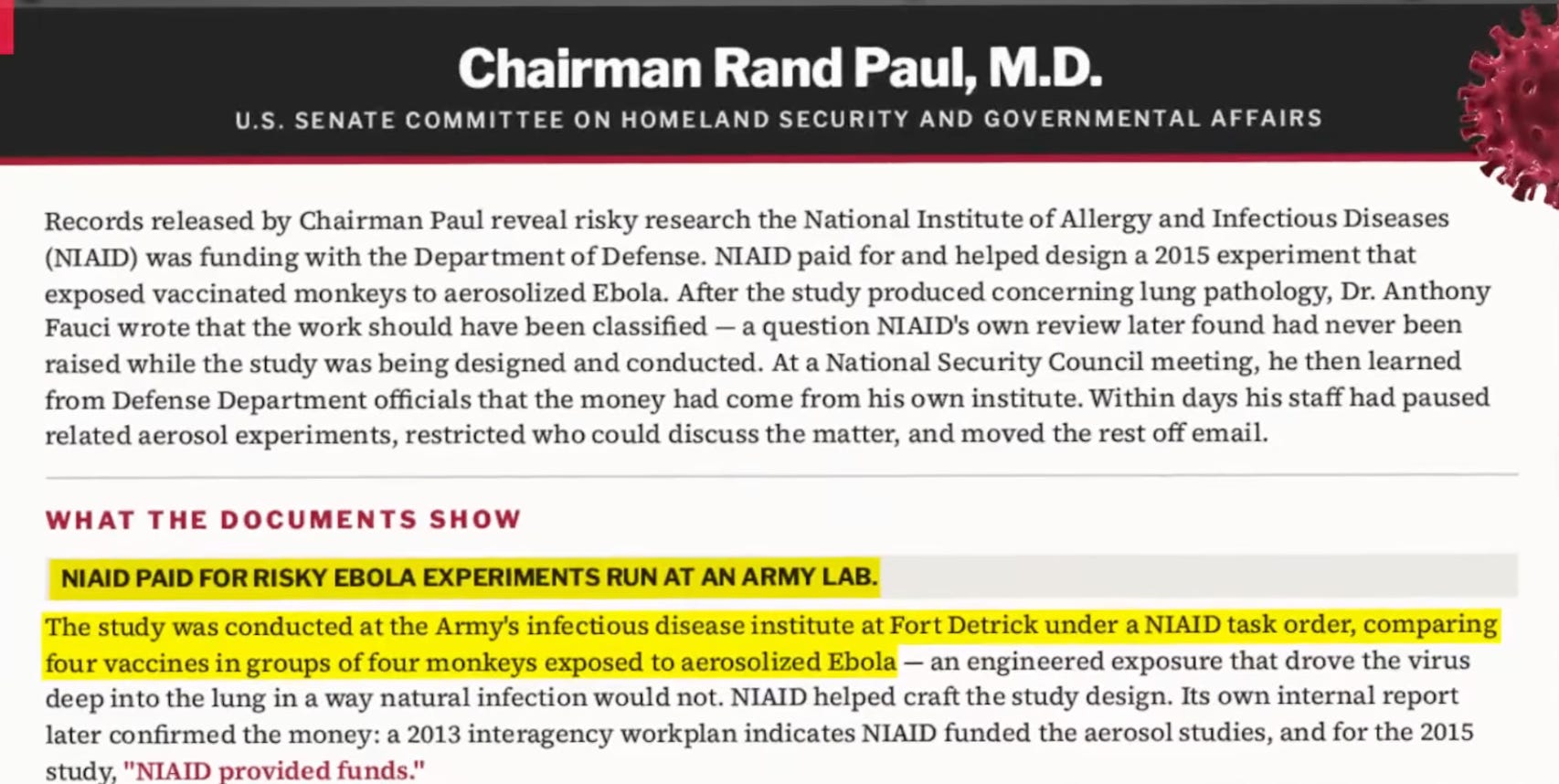
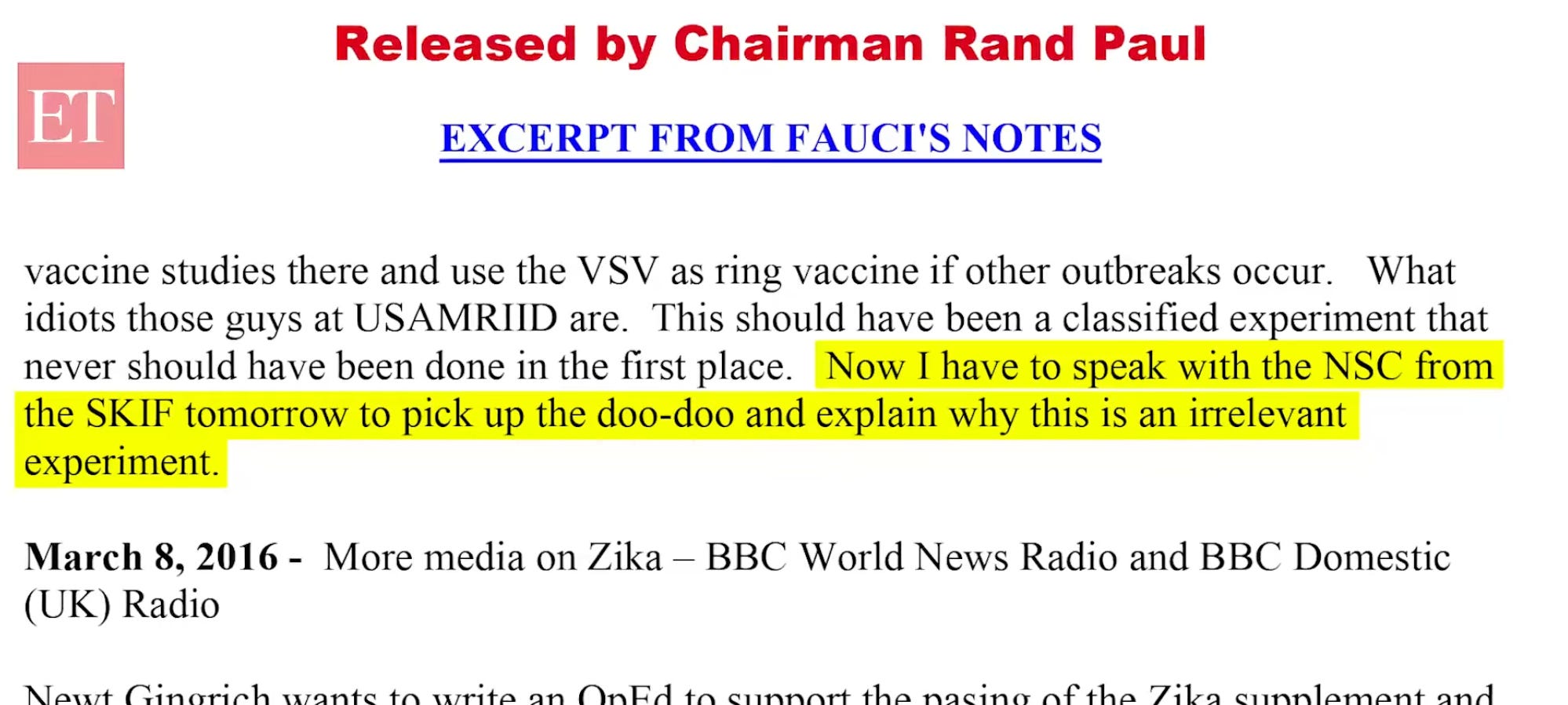
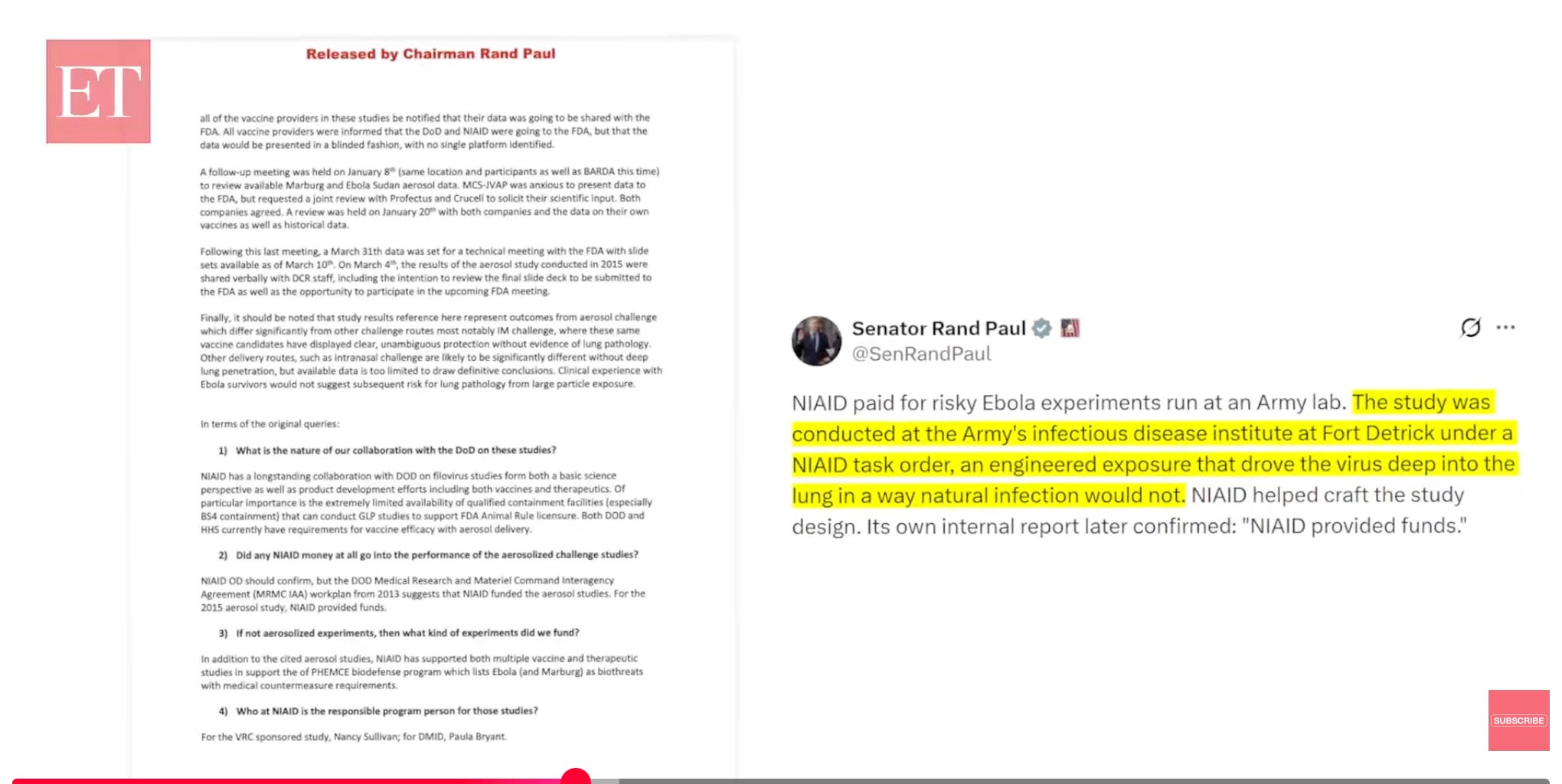
The newly publicized records being highlighted by Senator Rand Paul add another layer. According to Paul’s investigation and reporting based on Fauci’s diary entries, Fauci learned in 2016 about an Army-associated experiment involving experimental Ebola vaccines followed by aerosol challenge and reacted very negatively, reportedly describing it as an experiment that should not have been done. Senator Paul has used these records as part of his broader criticism of federal oversight of high-consequence pathogen research. Those are Paul’s claims and interpretation of the documents, not an independent scientific conclusion, but the underlying existence of aerosol Ebola research at Fort Detrick is independently documented in the published literature. Homeland Security Committee
And perhaps this is where I am getting old, because there was apparently a meeting somewhere where intelligent people said, “You know what we should do today? Aerosolize Ebola.” I complain when one of my kids spills water three feet from the kitchen table. These people are putting one of the most lethal viruses humans know into tiny airborne particles and delivering it directly into primate lungs. Different Tuesday, I suppose.
There actually is a serious rationale for this research. Governments worry about biological warfare. If someone deliberately aerosolized a dangerous pathogen, military researchers want to understand what happens and whether existing countermeasures would work. Earlier studies from the Army specifically describe this biodefense concern, and vaccine research has shown that some experimental Ebola vaccines can protect nonhuman primates even against lethal aerosol challenge. One adenovirus-based vaccine study reported protection against both parenteral and aerosol Ebola exposure, and another aerosol-vaccine experiment generated strong respiratory immune responses in rhesus macaques.
So this is not a story where every Ebola vaccine failed and researchers discovered that vaccination universally makes Ebola worse. That would be a much cleaner headline, which is probably why the internet will inevitably turn it into that by lunchtime.
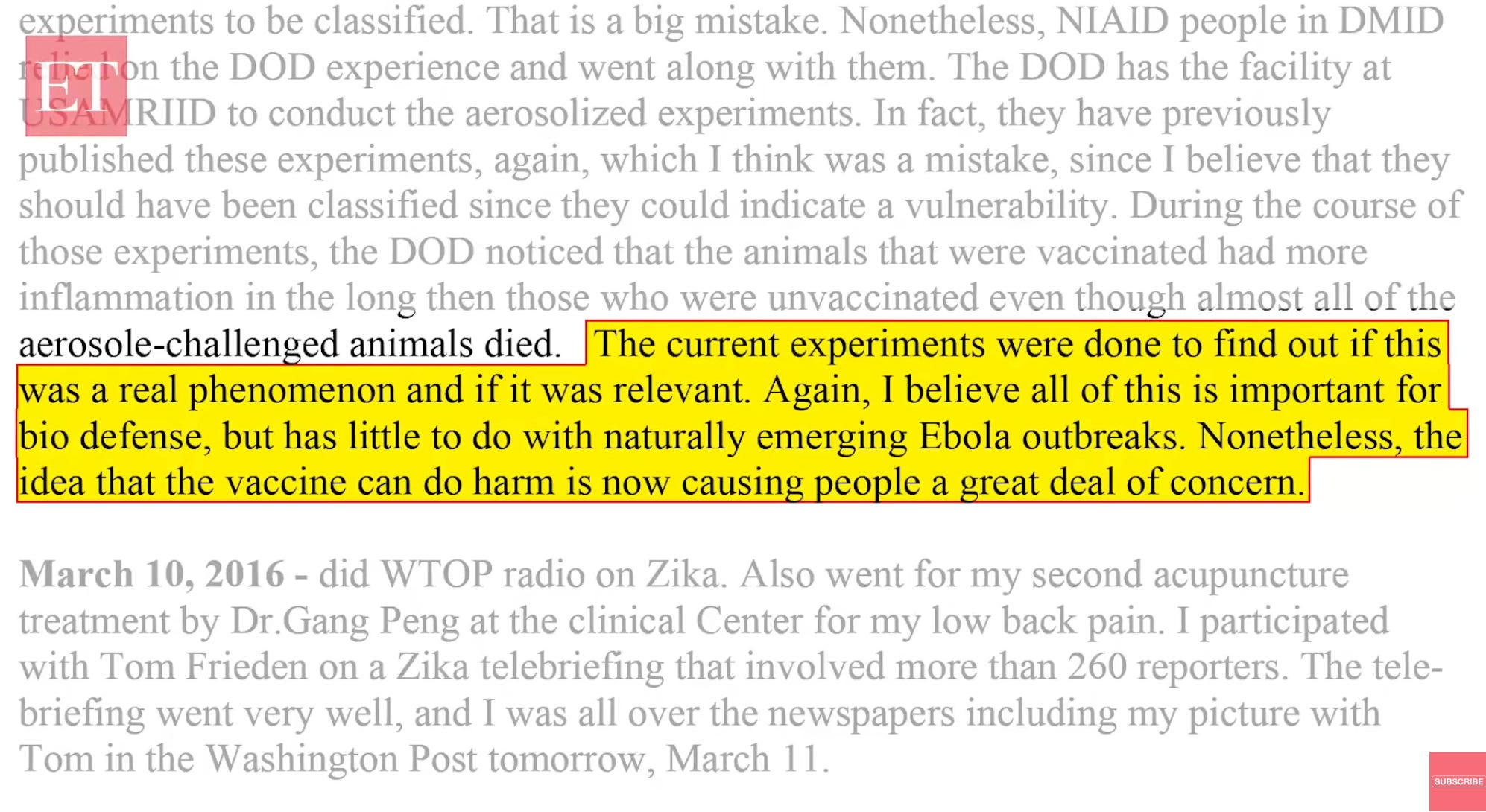
The more complicated—and much more interesting—issue is what reportedly happened in the particular experiment discussed in Fauci’s notes. According to the records now being highlighted, vaccinated animals developed concerning inflammatory pathology in the lungs following aerosol challenge. Reports based on the documents describe necrosis, inflammation, and fibrin deposition in vaccinated animals that were apparently not seen in the small unvaccinated control group.
What they appear to document is a signal—an unexpected difference in lung pathology in this specific artificial exposure model—which officials considered concerning enough to investigate further. Signals are exactly what scientists are supposed to investigate. They can turn out to be real. They can turn out to be random. They can disappear in larger studies. They can apply to one vaccine platform and not another. They can also teach us something important about immunology that nobody expected. That is why we do science rather than just voting on the answer in the comment section.
That is not all the bothers me
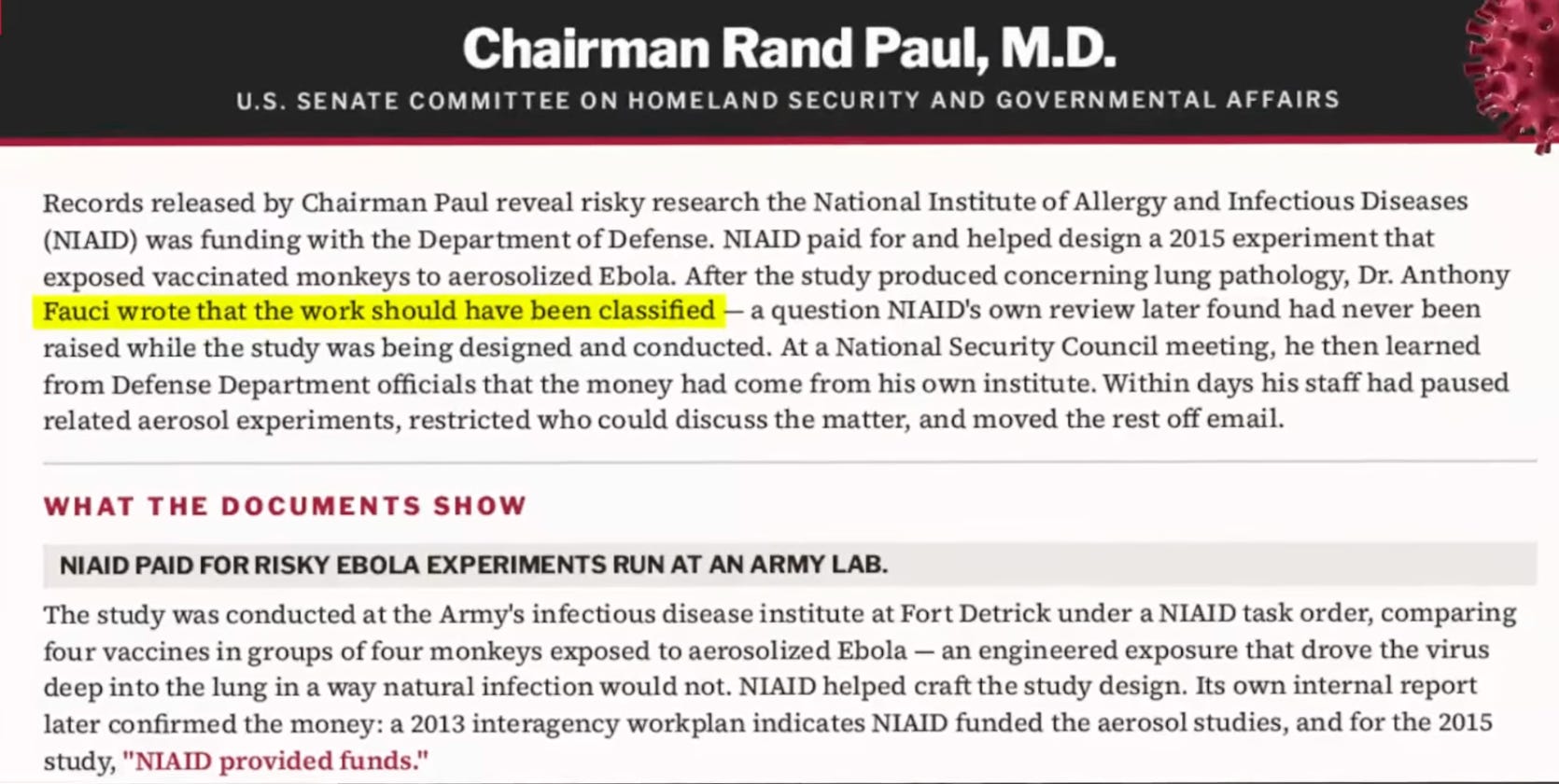
But then I arrive at the part of this story that bothers me in an entirely different way: the reported concern over vaccine confidence. According to the records being cited by Paul and subsequent reporting, Fauci was worried that these findings could create fear around Ebola vaccination and reportedly believed aspects of this kind of work should have been kept classified. I understand part of that argument. If you are studying an artificial method of delivering Ebola as a weapon, there may legitimately be national-security information that should not appear on the front page of Google next to “10 Easy Weeknight Dinners.” But national security and protecting vaccine confidence are not the same justification.
That distinction matters a lot to me.
If a scientific finding is misleading, explain why. If the experimental model is unrealistic, explain that. If the control group has two monkeys, point that out. If subsequent experiments fail to reproduce the finding, publish those too. If one experimental vaccine has an unexpected problem, study the living daylights out of that vaccine. What I never want to hear is some variation of, “People might lose confidence if they know about this.” Confidence in medicine should not be something we manufacture by deciding which facts are emotionally convenient enough for people to hear. Confidence should be the byproduct of doing good science and telling the truth about it. This seems so obvious that I feel slightly ridiculous writing it, but apparently we need to keep writing it.
And I think public health sometimes falls into a strange trap here. Officials become so afraid of people misinterpreting a safety signal that they start treating the signal itself as dangerous. Then eventually someone finds the email, the diary entry, the unpublished discussion, or the meeting notes, and suddenly the story is no longer simply, “Scientists saw something unexpected and studied it.” It becomes, “What else didn’t they tell us?” Congratulations, we have now converted a potentially explainable scientific finding into a trust problem with accessories.
It is also important not to lump every vaccine into one giant biological bucket. We talk about “vaccines” as though a rabies vaccine, an mRNA COVID vaccine, MMR, tetanus toxoid, an experimental Ebola vector vaccine, and a flu shot are basically cousins wearing matching sweaters. They aren’t. Platforms differ. Antigens differ. Adjuvants differ. Routes differ. Immune responses differ. So even if an adverse phenomenon were conclusively demonstrated with one Ebola vaccine candidate under aerosol challenge, that would not automatically tell us anything about childhood MMR or influenza vaccination.
But—and this is where I think the conversation becomes uncomfortable—we should also not use that fact as an excuse to avoid asking whether similar biological phenomena have occurred with other specific vaccines. Vaccine science has long investigated issues such as altered disease severity, immune interference, shedding, heterologous effects, and changes in susceptibility to other infections. Sometimes a concerning hypothesis falls apart under better research. Sometimes it doesn’t. The only scientifically defensible position is to remain willing to look.
That should not be controversial.
“Could this happen?” is a question.
“Let’s never study it because people might get nervous” is public relations.
Medicine should be doing the first one.
And then there is the enormous elephant wearing a hazmat suit in the room: what are we comfortable experimenting with at all?
High-consequence pathogen research exists for legitimate reasons. Ebola is a potential biodefense threat. The United States has studied aerosol Ebola pathogenesis for decades precisely because militaries and governments have to contemplate unpleasant possibilities that the rest of us would prefer not to think about. But “there is a legitimate reason” cannot be the entire risk-benefit analysis. There is a legitimate reason to study nuclear reactions too. That doesn’t mean we conduct the experiment next to the preschool because parking is easier.
Laboratory containment can be excellent and still not be infallible. Human beings run laboratories. Human beings make mistakes. They spill coffee on themselves while sitting completely still. Give us enough time and we can accidentally lock ourselves out of a car while the keys are visibly sitting on the driver’s seat. So when the object being handled is Ebola rather than a Starbucks cup, I think society has every right to ask exactly what benefit justifies the risk and who independently decided the experiment was worth doing.
That concern is not imaginary. Senator Paul has continued raising oversight questions about high-risk pathogen work at federal biodefense facilities, including recent claims about aerosol experiments involving several dangerous pathogens at the National Biodefense Analysis and Countermeasures Center, which sits near NIAID’s Integrated Research Facility at Fort Detrick. His committee has sought records from multiple federal agencies as part of a wider investigation into oversight of risky biological research. Those efforts are politically contested, and Paul is an outspoken critic of Fauci and federal research policy, so his interpretation should be understood in that context. Still, the core policy question—how much risky pathogen research should government fund, and under what safeguards—is completely legitimate.
Ironically, one of the things I find most interesting in the Fauci material is that, at least according to the released accounts of his private notes, he seemed disturbed by the experiment too. This isn’t a simple cartoon where Fauci sits in a dark room cackling while someone turns up the Ebola aerosol machine. His reported reaction was that the work shouldn’t have been done and that he wanted to know how NIAID had become involved.
Good.
That is exactly the reaction I want when leadership discovers an experiment that may have crossed an appropriate risk threshold. Where I part ways is with the idea that a potential blow to vaccine confidence should influence how openly an unexpected biological finding is discussed. There may be legitimate reasons to classify information about how to weaponize a pathogen. “People might start asking questions about vaccines” should not be one of them.
The great irony is that transparency is probably the best vaccine-confidence program anyone could design.
Tell people vaccines have benefits. Tell them they have risks. Tell them when the evidence is strong. Tell them when something weird happened in four monkeys. Tell them when the next experiment didn’t reproduce it. Tell them when you made a mistake. Tell them when you genuinely don’t know. The public is not made of porcelain. Parents especially aren’t.
They spend half their lives being handed terrifying information anyway. The school nurse calls at 10:07 AM and says, “Everything is probably fine, but…” and your heart rate has already reached 180 before she finishes the sentence. We can handle nuance.
What is much harder to handle is discovering years later that somebody decided nuance was too dangerous for us. That is how you destroy trust.
So I don’t read these records and conclude that Ebola vaccines are bad, much less that every vaccine is bad. I read them and see something much more interesting: a high-risk experiment that apparently made even Fauci uncomfortable, an unexpected pathological finding that deserved follow-up, and another example of public-health officials wrestling with whether transparency might undermine confidence.
My answer to that last problem is simple. Let confidence take the hit. If the science is good, confidence can recover. If the science isn’t good, maybe confidence should take the hit. Medicine is not supposed to protect the reputation of medicine. It is supposed to protect human health.
And if one experimental Ebola vaccine produced a concerning result under a bizarre aerosol challenge, the job isn’t to panic. It isn’t to extrapolate it to every vaccine ever invented. And it definitely isn’t to hide it. The job is to figure out what happened.
Also, possibly—and I say this as someone with no formal training in how to spend an afternoon at Fort Detrick—maybe we could aerosolize slightly less Ebola while we’re figuring it out.
A-fucking-men!
Now, go one step further . . .
What you have said here is obvious, isn't it? Confidence comes from being told the truth. The thing is, we so-called "anti-vaxxers" have been telling the CDC and NIH folks that for DECADES.
Do you think they don't understand that?
Come on. People like Fauci aren't stupid, just manipulative.
What was their response? "You people are anti-science conspiracy theorists!"
Ad hominem may be a logical fallacy, but it's been an effective deflection for millennia.
What is it their ad hominem is deflecting from?
Isn't it likely that if the news about vaccine safety were actually GOOD, they'd be yelling it from the rooftops?
But they are doing the opposite, which means they themselves are afraid to either learn the truth or tell the truth.